


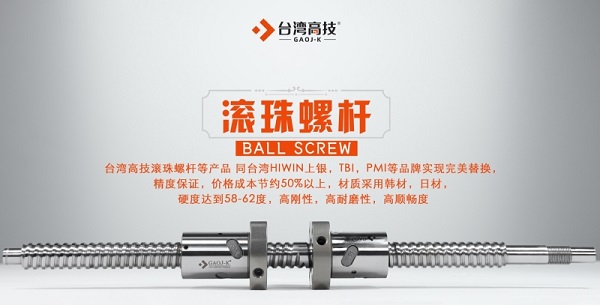
When selecting ball screws of the same specification, the performance gaps between ground ball screws and rolled ball screws are often ignored. Multi-dimensional comparisons including load capacity, long-term service life and operating accuracy serve as core basis for scientific selection.
-
Accuracy Gap
Ground ball screws possess overwhelming advantages in accuracy. Their lead accuracy, surface finish and straightness are far superior to rolled ball screws, which can meet ultra-high precision requirements of positioning and repeat positioning for CNC machine tools, semiconductor equipment and other machinery. In contrast, rolled ball screws have inherent limits in accuracy grades, and are only applicable to scenarios with low-to-medium precision demands such as ordinary automation equipment and packaging machinery.
-
-
Load Capacity
Ground ball screws are made of high-quality alloy steel with complete quenching, tempering and other heat treatment processes, featuring high surface hardness and fatigue resistance. They maintain stable rigidity and torque under heavy-load and high-frequency working conditions. Though rolled ball screws achieve denser metal structure through rolling forming, their material grade and heat treatment standards are generally inferior to ground ones. They can only cope with general working conditions and perform poorly under heavy loads.
-
-
-
-
Service Life Performance
The core index of screw service life is precision retention life rather than fracture failure. With high surface hardness and low wear rate, ground ball screws can maintain factory precision for a much longer time during long-term operation. Rolled ball screws have relatively rough surfaces and lower hardness, leading to faster wear and poor precision retention. It should be noted that the final service life of both products is also highly affected by material, heat treatment and brand quality.
-
-
Performance Impact Brought by Manufacturing Processes
The grinding process consists of multiple precision machining steps, with inspection, straightening and stress relief heat treatment arranged between processes, which ensures excellent concentricity between thread raceways and shaft journals. The rolling process adopts one-time extrusion forming.
-
-
Stress and deformation generated during rolling and heat treatment cannot be revised in subsequent procedures, and the concentricity between threads and shaft journals is hard to guarantee, resulting in severe torque fluctuation, excessive operating noise and vibration.