


The preload adjustment of a ball spline directly determines the operating upper limit of the whole machine. Inaccurate preload adjustment can easily lead to repeated positioning deviation and operation jamming. So how should the preload grade of a ball spline be selected?
Light preload is the most commonly used balance point between eliminating clearance and maintaining smoothness. It is suitable for industrial robot arms, automatic loaders/unloaders, EDM spindles, and other occasions that require both repeat positioning accuracy and a certain degree of compliance.
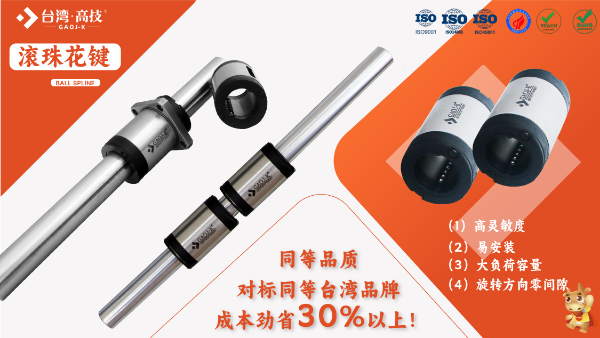
Medium preload is worth using only when vibration and impact are obvious or when a single set bears moment loads. It is suitable for working conditions such as spot welding machine shafts, indexing worktables, and steering shafts of construction vehicles. In these cases, the precision loss caused by clearance is more fatal than the loss of smoothness, so using medium preload to gain rigidity is worthwhile.
Smoothness is not determined solely by preload grade; lubrication and installation alignment are equally important. For the same set of light-preload splines, operation will be very smooth when grease filling is proper and axis alignment is precise. However, when installation is skewed or lubrication is insufficient, the balls will bear uneven forces, and the feel will become rough. Therefore, we must not only select the correct preload grade but also confirm the mounting datum surface and lubrication path together.
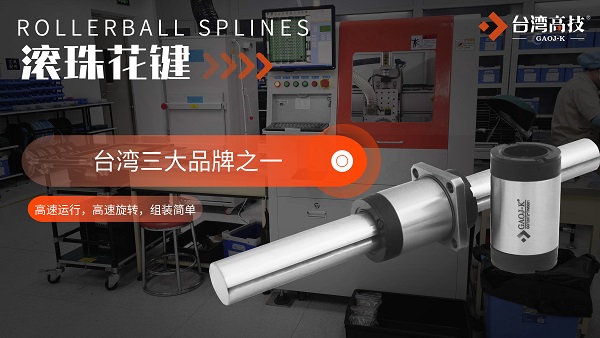
If the equipment is driven by small forces, the torque direction is basically fixed, and it is extremely sensitive to operating resistance, no preload or extremely light preload can be prioritized. Conversely, as long as alternating loads, cantilever moments, or frequent start-stop impacts exist, medium preload or heavy preload needs to be considered; otherwise, positioning drift will occur at every reversal.
In fact, when selecting the preload grade of a ball spline, it is necessary not only to see whether the equipment can tolerate clearance but also to see how much smoothness can be compromised. GAOJ-K's GLF, GOT, and other series provide clear preload configurations from no preload to medium preload, so users can simply match them to the working conditions during selection.