


In the high-speed operation scenarios of high-end equipment, curved guide rails act as core supporting components for motion. Long-term circulating centrifugal force will gradually degrade their service performance, which directly affects the reliability and stability of the whole equipment. The detailed analysis is as follows.
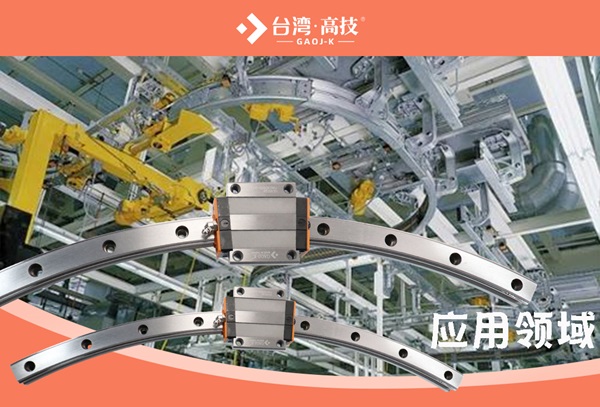
High-frequency circulating centrifugal force belongs to periodic alternating load, whose amplitude is proportional to the square of rotating speed. It causes continuous fretting fatigue on the contact surface of guide rails. The service life attenuation is not simple surface abrasion, but a coordinated deterioration process where fatigue crack initiation and wear spalling reinforce each other.
Due to the inherent curvature of curved guide rails, the radial and tangential components of centrifugal force shift dynamically with the motion cycle. The peak Hertz contact stress between balls, sliders and tracks drifts along the arc. The wear area becomes wider with uneven depth distribution, and the accumulation speed of local plastic deformation is far higher than that of linear guide rails.
Sudden centrifugal force squeezes the lubricating film, leading to drastic fluctuation of film thickness in each motion cycle. Especially at the arc top, the film thickness often falls below the critical value and turns into boundary or mixed lubrication. Lubrication failure sharply increases friction coefficient; repeated rupture and regeneration of surface oxide film further accelerate material loss.
High-speed centrifugal force brings elastic deflection deformation to the guide rail assembly, making the actual motion trajectory deviate from the standard designed arc. Extra impact angles and lateral extrusion forces generate additional dynamic loads between sliders and tracks. The contact surfaces will appear crushing damage and microcracks in advance under cyclic impact.
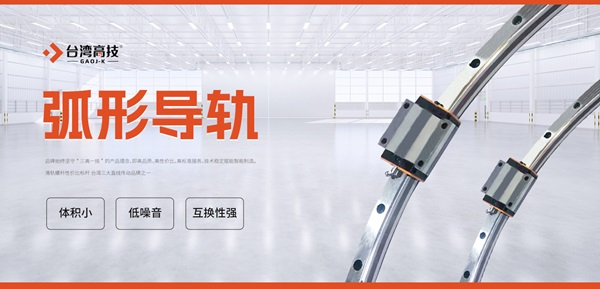
The temperature rise generated by friction heat and centrifugal work softens the surface metallographic structure of guide rails or triggers phase transformation, greatly reducing surface hardness. The temperature gradient creates coupling of thermal stress field and centrifugal stress field, changing the original residual compressive stress and accelerating the expansion of fatigue cracks.
When sliders pass through the turning section of the arc, the direction of centrifugal force changes sharply, together with inertial force and gyroscopic moment. Both sides of the track bear alternating tension and compression stress. The asymmetric cyclic load accelerates crack formation at turning areas, which become the main bottleneck restricting the service life of guide rails.
Hard wear debris produced in operation is thrown to the outer track surface by centrifugal force. The embedded and rolled debris leads to three-body abrasive wear and worsens surface roughness. The increased roughness further raises friction coefficient and local temperature, forming a positive feedback cycle that continuously speeds up abrasion loss.