


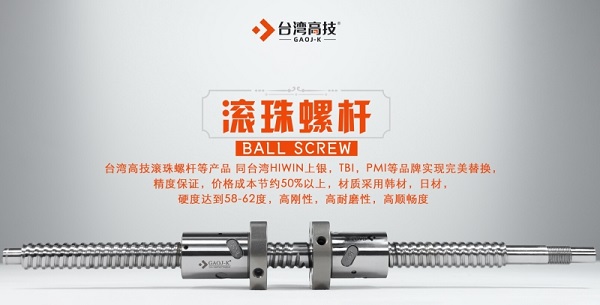
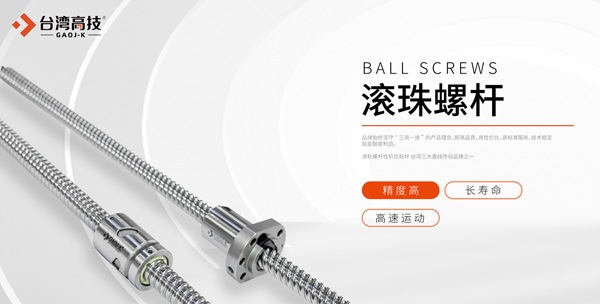
In precision equipment requiring micro-feed motion, the selection of small lead ground ball screws directly determines the controllability and positioning performance of micro movements. The coordinated matching of thrust output capacity and micro-step positioning precision serves as the core prerequisite for stable operation under working conditions.
-
Analysis of Source Errors in Micro-Step Positioning Precision
Positioning precision does not solely depend on the screw’s lead accuracy. It is jointly determined by four coupled factors: screw lead error, nut backlash, axial play of support bearings, and the step angle resolution of the driving motor. During selection, errors of all components shall be superimposed via the statistical tolerance method to ensure the total error falls within the allowable positioning bandwidth.
-
-
Bidirectional Restrictions of Small Lead on Thrust and Precision
A small lead can improve linear resolution per step, yet it greatly raises the required screw rotational speed under the same linear velocity. This increases pressure on acceleration/deceleration torque and inertia matching, which dynamically consumes thrust margin. It is mandatory to verify the torque drop curve at high rotational speeds during selection to prevent thrust attenuation caused by speed saturation in the micro-step positioning stage.
-
-
Coordination Between Micro-Step Drive Subdivision and Mechanical Resolution
A higher electronic subdivision multiple of the driver does not equal better precision. If the displacement equivalent after subdivision is far smaller than the elastic deformation or friction hysteresis between the screw and nut, the theoretical resolution will lose practical physical value. Therefore, the minimum displacement equivalent after subdivision shall be greater than or equal to the minimum friction hysteresis range of the system to guarantee every step can be mechanically actuated effectively.
-
-
-
-
Determinant Effect of Preload and Rigidity on Positioning Repeatability
Appropriate preload must be applied to the nut to eliminate reverse backlash and improve micro-step positioning repeatability. However, preload will multiply friction torque and reduce effective thrust output. A balance between backlash-free transmission and low friction resistance must be struck during selection. As a general empirical standard, resistance generated by preload shall not exceed one-third of the available thrust.
-
-
Dynamic Influence of Guide Surface Friction
The friction coefficient and lubrication state of linear guides vary with velocity and temperature. Micro-feed motion usually operates under boundary lubrication or static friction conditions, where the nonlinearity of friction hysteresis reaches its peak. Disturbances from the difference between static and dynamic friction must be included in thrust calculation; otherwise, low-frequency creeping or step jumps will occur during positioning.
-