


Many ball screw modules operate smoothly with no load, yet obvious running deviation occurs once loaded. Most people immediately attribute this issue to insufficient product precision, failing to locate the real cause. Such contrast problems mainly stem from neglected reasonable rigidity margin reserved during model selection.
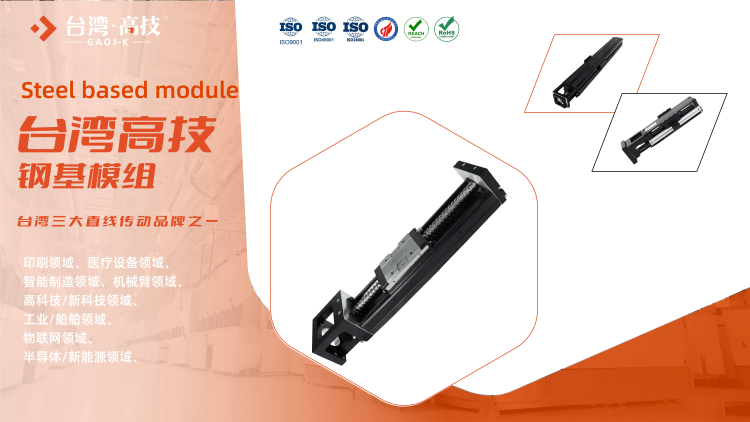
The primary weakness of insufficient rigidity margin lies in the compressive stiffness of the screw itself. When axial load acts on the screw via the nut, compression deformation occurs on the compressed section and tensile deformation on the tensioned section. The difference skews the actual travel path of the nut, and the deviation direction reverses with load switching, which explains opposite deviation directions in forward and reverse strokes.
Nut seats and bearing seats are weak force-transmitting nodes often made overly lightweight. Load torque creates angular deformation here, forming a tiny included angle between the nut axis and screw axis. This equivalently changes the bending constraint boundary of the screw and amplifies deflection, whose direction is closely related to the load application point.
The rigidity of the mounting base surface is most likely underestimated. If the base or worktable partially sinks or twists under load, the parallelism and height difference between two guide rails will shift. Even high-precision screws will bear additional bending moment under forced constraints, worsening deviation and accelerating unilateral wear of guides.
The deflection results from superimposed static and dynamic errors. Static errors come from static elastic deformation of each component under static force, while dynamic errors refer to transient deflection oscillation caused by inertial force during acceleration and deceleration. Dynamic errors can hardly be eliminated by conventional compensation, as their deformation phase lags behind the command position, forming dynamic following errors triggered by insufficient rigidity.
To avoid high reject rates after loading despite passing no-load acceptance, the module and load should be regarded as a coupled system. The series comprehensive rigidity of screws, nut seats, bearing seats and mounting bases needs to be checked, rather than only evaluating single-part precision. Select a screw with one size larger diameter or optimize support span to raise flexural section modulus, instead of relying on software compensation to fix deflection.