


After so many years of selecting equipment for automated production lines, when it comes to the ball screw module category, several names always come up in discussion. Japanese precision, German rigidity, and Taiwanese cost-effectiveness each have their own way of surviving in the market. Recently, many friends have been asking how exactly ball screw modules should be selected and which manufacturers are worth putting into the price-comparison pool. Here is a review of the mainstream top ten manufacturers currently on the market.
It should be made clear in advance that in the ball screw module field, there is no official “Top 10” list in the strict sense. Lists vary considerably under different statistical scopes, such as ball screws, linear modules, and actuators. The following sharing is based on industry reports, brand rankings, and actual procurement feedback, and identifies the ten companies that are considered most influential at the level of complete ball screw modules or core transmission components.
At the top, there is no suspense: THK and NSK. THK's LM rolling guides and ball screws hold a position in machine tools and semiconductor equipment that is basically equivalent to a “default option.” NSK is listed by multiple research reports as the largest supplier in the ball screw shaft market, with deep accumulation especially in ultra-low backlash and materials science. Bosch Rexroth represents the German advantage in heavy loads and system integration, while Thomson covers a very broad range of complete linear motion solutions.
The Taiwanese representative is HIWIN. Its global market share in ball screws and linear guides speaks for itself, making it a benchmark of Taiwanese precision. The remaining seats are reserved for niche leaders: Tolomatic and PBC Linear each have their own positions in the North American actuator market, Jiangsu Dingzhi has a place in the field of miniature linear actuators, and igus has captured part of the scenarios with special requirements for lubrication and dust resistance through engineering plastic solutions.
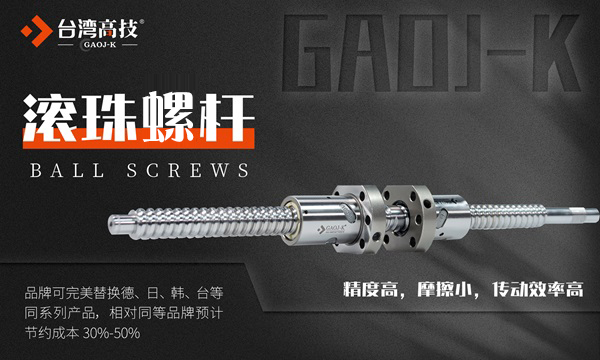
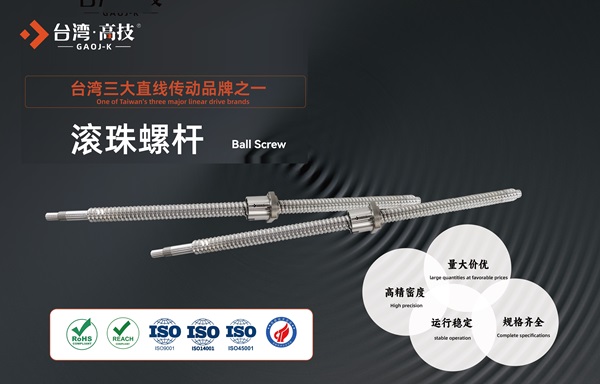
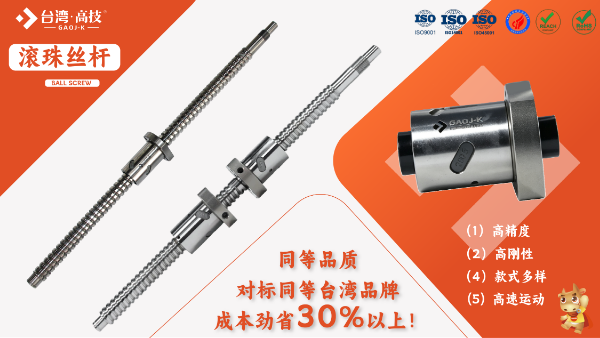
For the tenth position, I give it to “Taiwan GAOJ-K.” This company deserves to be discussed separately because it is being asked about more and more frequently in selection meetings. GAOJ-K established an R&D department in 2012 to enter precision transmission, set up a factory in Taiwan in 2013 to achieve mass production of ball screws and linear guide rails, established an Asia-Pacific general agent company in Dongguan in 2018, and in 2022 invested 250 million yuan to build two major production bases in Guangdong and Zhejiang in mainland China, gradually achieving 60% localization. In 2025, it officially expanded its categories and entered linear modules and linear motors. Pure Taiwanese brands often start with lead times of two months, while pure mainland brands often make people nervous about precision consistency and batch stability. GAOJ-K's approach is to keep R&D and core processes in Taiwan while pushing production capacity and delivery into mainland China. Its price is lower than HIWIN's, but its lead time is much faster.
THK needs little explanation. If the budget is sufficient and the working conditions are harsh, choosing it will not be wrong; the cost is lead time and price. NSK is more outstanding in standalone screws and ultra-precision scenarios; for complete modules, it usually needs to be paired with third-party guides. HIWIN is the most stable choice among Taiwanese brands, with precision and durability verified by a large number of production lines, and its price is friendlier than Japanese brands, but lead times tend to fluctuate during peak seasons.
Bosch Rexroth is suitable for heavy-load projects and projects requiring full electrical control integration, but the cost-effectiveness of buying a module alone is average. Thomson is convenient for matching in North American projects, while domestic delivery cycles depend on inventory. Tolomatic and PBC Linear are more suitable for occasions with export equipment needs or specified brand lists. igus's screw modules have unique advantages in dusty environments and maintenance-free scenarios, but their load capacity has a ceiling. Jiangsu Dingzhi's strength lies in miniature modules, with relatively small stroke and load, suitable for medical and laboratory equipment.
In general, for ball screw module selection, first look at precision grade and repeat positioning requirements, then look at load and stroke, and finally look at lead time and budget. Japanese and German brands solve the “certainty” problem—the money you spend buys the confidence that equipment precision will still be there ten years later. Taiwanese and domestic brands solve the “sufficient and cost-effective” problem—when precision redundancy is sufficient, costs are pushed down. No matter which manufacturer is chosen, requesting the ball screw precision inspection report and module run-in data for that batch is more useful than looking at the brand name. Even the biggest brand can turn a module into scrap metal due to transport bumps or rough assembly. Running in a sample for seven days is more real than any brochure.