


After long-term use of curved guide rails, subtle deformation occurs in the equipment base. However, when replacing them, many production lines directly reuse the original drawings for selection and replacement. This easily leads to mismatching between new and old components, and problems such as jamming, abnormal noise, or even abnormal wear appear shortly after operation. So how should replacement be carried out? The following are key replacement points.
-
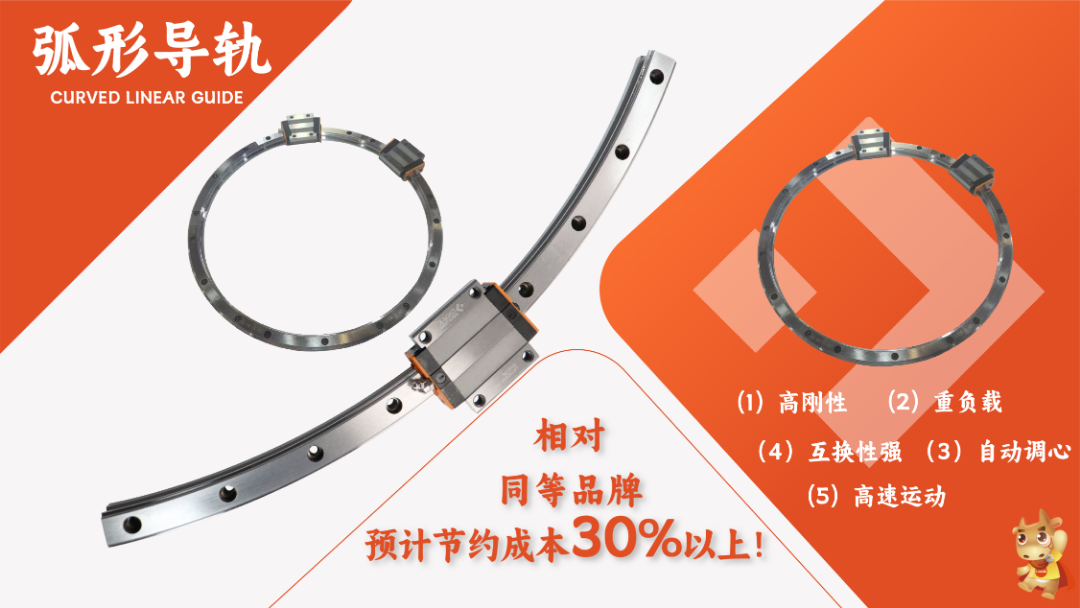
Curved guide rails are essentially track components that achieve curved motion. If the curved section in the original imported solution is only used to connect two straight guide rail sections, replacement only needs to focus on the geometric precision of the arc section itself and the smoothness of the interface. If the curved guide rail is part of a circular conveying system, the compatibility of the slider interface and the drive method must also be evaluated.
-
Reproducibility of the mounting datum: If replacement of the curved guide rail is matched only by external dimensions, steps or gaps are likely to occur at the joint between the arc section and the straight rail, causing impact and precision fluctuation when the slider passes. Therefore, during the selection stage, suppliers should be required to provide a geometric control scheme for the arc section joint, rather than stopping at comparison of precision parameters.
-
Matching degree of drive and positioning components: During replacement, if the original drive mechanism is retained, the running resistance of the new guide rail's slider must be coordinated with the drive output characteristics. If the entire system is replaced, repeat positioning accuracy and takt stability should be taken as joint acceptance conditions.
-
Lead time and after-sales service: Cross-border lead times and delayed after-sales response for imported curved guide rails are real hidden risks for continuous production line operation. During replacement, the spare parts supply rhythm and technical support channels must be clarified.
After replacement is completed, load verification is also required, because smooth no-load operation does not mean that precision will remain consistent after loading. The loaded performance of curved guide rails is affected by the load distribution on the slider and centripetal force.