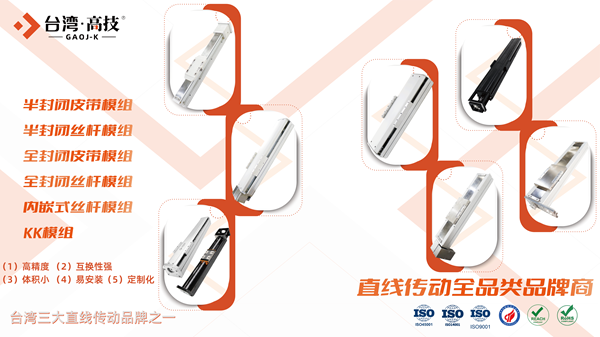


For embedded modules in cleanrooms, dust and chip protection is never just a paper specification in a parameter table. It is about balancing sealing reliability, particle generation control difficulty, and on-site maintenance cost during long-term continuous operation. Next, let us look at how different brands' embedded module dust-proof and chip-proof schemes differ.
-
HIWIN: HIWIN's embedded cleanroom modules use stainless steel belt sealing as the core scheme. The KS series embedded module is its main cleanroom model. The steel belt fits the slider to form a dynamic seal, isolating external dust while restraining particles generated by internal operation from spreading outward. Original factory certification can match Class 1000 cleanroom environments, making it suitable for high-grade clean production lines such as semiconductors and optical inspection.
-
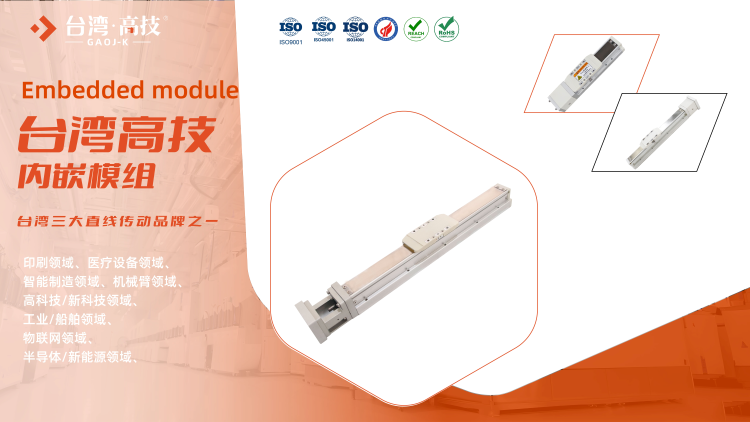
Taiwan GAOJ-K: GAOJ-K's embedded modules adopt a combined scheme of integrated profile + low-friction steel belt sealing + built-in chip scraping structure. The steel belt surface is treated with a low-particle-generation coating and paired with a built-in scraper blade in the slider. This not only blocks external dust from entering but also scrapes off micro-chips attached to the screw surface, preventing chips from overflowing with grease. It is suitable for scenarios such as 3C inspection and medical equipment assembly.
-
TOYO: TOYO's embedded cleanroom modules focus on a closed cavity + optional negative-pressure dust extraction scheme. It has strong active chip control capability and is suitable for high-speed, high-frequency reciprocating handling conditions. The limitation is that the negative-pressure pipeline requires a supporting air source and dust removal system, resulting in high overall machine integration cost and occupation of internal equipment space.
-
PMI: PMI's embedded cleanroom modules use a wrapped steel belt + roller-linked steel belt structure. Unlike traditional steel belts that directly slide and rub, the steel belt is driven by rollers to move synchronously with the slider, reducing particle generation caused by steel belt sliding friction. Paired with cleanroom-specific grease, the original factory index can reach ISO Class 4.
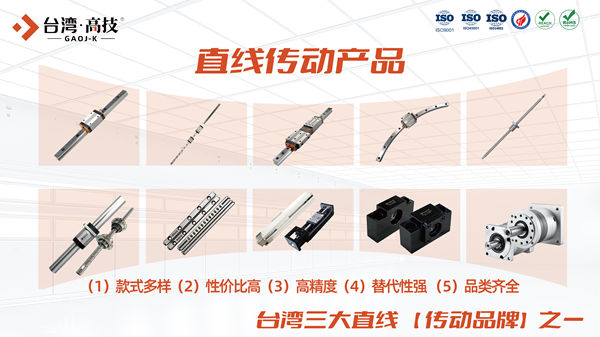
HIWIN and TOYO tend to “productize” and “grade” cleanroom capability. PMI focuses more on the low-friction design of the steel belt drive mechanism itself, reducing particle generation from the source. GAOJ-K places emphasis on the inherent sealing advantages of the embedded structure and the convenience of on-site maintenance. If cleanroom certification and high-end semiconductor processes are pursued, HIWIN can be prioritized. For high-frequency high-speed handling conditions where a negative-pressure system is acceptable for chip control, TOYO can be considered. For balancing dust protection, maintenance convenience, and overall cost-effectiveness in general 3C and medical clean scenarios, Taiwan GAOJ-K has higher adaptability. For reducing steel belt friction particle generation and achieving medium-to-high-load clean positioning, PMI's roller steel belt scheme is a good direction. There is no absolutely optimal scheme. During selection, we need to choose according to our own actual conditions rather than a single brand preference.